

Compute roadmap
The simple idea
Section titled “The simple idea”Large recordings are expensive to move. NEMAR therefore separates the authoritative source from the access format used for interactive work:
- The canonical source remains a versioned, BIDS-shaped dataset.
- A conversion can create derived Zarr stores organized for chunked reads.
- An edge Worker can serve only the metadata and chunks a browser asks for, with CORS and caching at the browser-facing boundary.
- A viewer or analysis tool can inspect a small part of a recording before transferring the whole file.
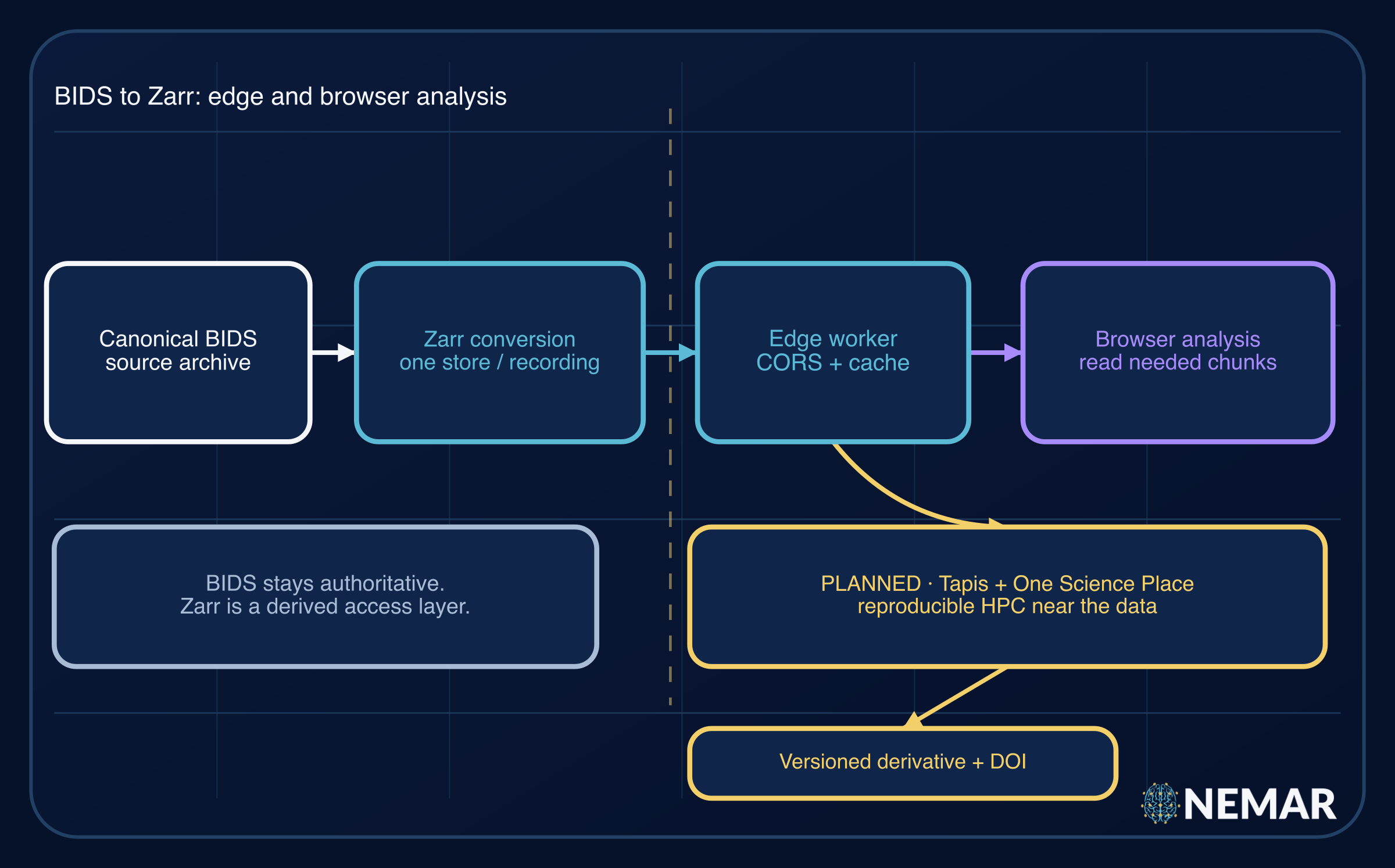
Figure 1. The BIDS source remains authoritative. Zarr and edge delivery are derived access layers; the HPC lane is a planned direction and is labeled that way in the figure.
What is available now
Section titled “What is available now”data.nemar.org provides the public BIDS-shaped view, including metadata, manifests, and file
paths. Where a recording has a serving-copy conversion, zarr.nemar.org provides the browser
gateway for its derived Zarr store. The conversion can be incomplete for a particular recording;
that state should be visible rather than hidden behind a blank viewer. See Zarr and edge access
for the access contract and the operations runbook for
implementation detail.
The SDSC and NSG bridge
Section titled “The SDSC and NSG bridge”NEMAR’s compute direction is grounded in its partnership with the San Diego Supercomputer Center (SDSC). The Neuroscience Gateway (NSG) is an established resource for the neuroscience community: it provides access to neuroscience tools and computing resources on HPC, HTC, and cloud infrastructure. NEMAR contributes the structured, open, citable data layer; our aim is to connect a NEMAR dataset, version, and workflow seamlessly to those established compute resources so they can become a reproducible analysis.
That partnership is what makes the data-to-compute loop practical. It is also why a planned NEMAR integration with Tapis through OneSciencePlace (OSP) matters: OSP uses Tapis for job and data lifecycle management, and its teams include UCLA, SDSC, and TACC. The goal is to connect NEMAR’s dataset and citation contracts to national HPC infrastructure rather than sending researchers back to rebuild transfers and environments by hand.
The planned HPC direction
Section titled “The planned HPC direction”We envision using Tapis through OneSciencePlace as an API layer for connecting NEMAR workflows to national HPC infrastructure. In plain terms, a researcher or an agent would be able to describe a reproducible job, select an approved compute resource, provide the dataset/version and inputs, and receive tracked outputs without manually rebuilding the entire transfer and execution workflow.
This is a roadmap, not a promise that every NEMAR dataset can already launch a national HPC job. The eventual design must still address authentication, allocation, data-use restrictions, software environments, provenance, cost, and the location of sensitive inputs. Where policy and infrastructure allow, the goal is to move only the data needed for a job or to schedule work close to the data.
What a useful result should contain
Section titled “What a useful result should contain”A compute result should be more than a file returned from a remote machine. The intended output includes the input dataset and version, the code or container used, parameters, the execution environment, logs or quality information, and a citable versioned derivative. That provenance is what makes an analysis reproducible and lets another researcher understand what changed.
The longer-term goal is a continuum: inspect a signal in the browser, run a small analysis near the edge, or submit a larger reproducible job to HPC using the same dataset and citation contracts.